08 Oct, 2026
Mobile App UI Design: 20 Essential UI Screens and Examples
What is Mobile App UI Design? Did you know that more than 90% of people globally spend their time using mobile apps?…



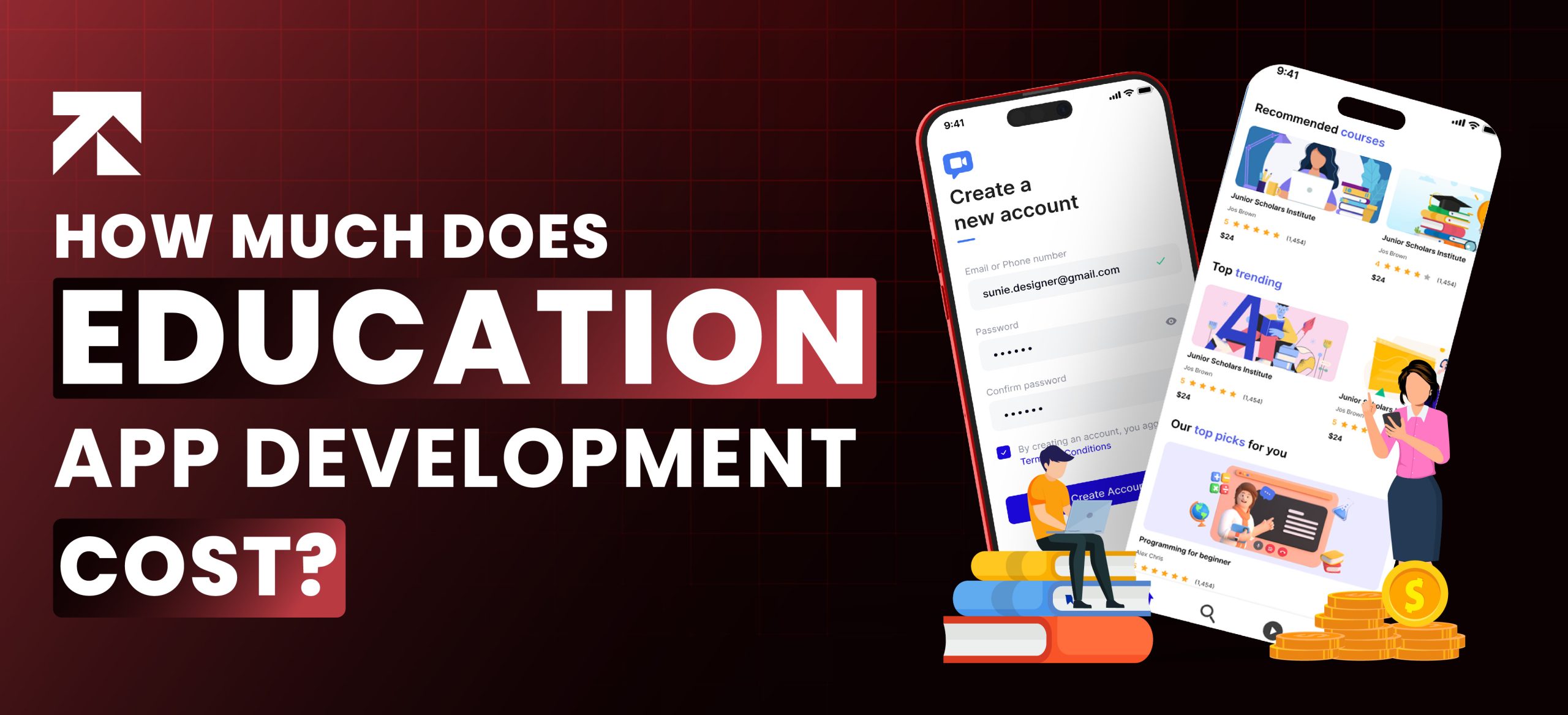
Education apps aren’t just a trend anymore; they’re the new classroom. According to a global forecast report by Research and Markets, the global education app market size is valued at USD 94.82 billion in 2026 and is expected to reach USD 165.15 billion by 2032.
This rapid expansion highlights an amazing opportunity for businesses to invest in mobile learning architecture.
But before entering the market, one question always comes up: How much does education app development cost?
It may range from $20,000 to $500,000, based on complexity, features, platforms, and the development team’s location.
This guide breaks it all down so you know exactly what you should expect and what you’re paying for.
The education technology market is massive and rapidly expanding.
Source: Smart education and learning apps market report

Before deciding to invest in the education app development market, you must understand its different types and the associated costs. It will help you decide which kind of application you want to create.
There are basically two types of educational apps, one for teachers and the other for students.
Let’s explore more about each type in detail.
There are multiple types of educational apps for teachers that help them improve their lesson delivery and monitor students’ performance.
Lesson-planning apps help teachers plan lessons more efficiently.
Key Features:
Examples: Google Classroom & Edmodo
Such apps allow teachers to manage the classroom operations smoothly, improve student engagement, and enhance communication between teachers and students.
Key Features:
Examples: Teacher-made, Remind, and ClassDojo.
This app specifically helps simplify the grading process by using automated test banks. It gives clear insights into students’ performance.
Key features:
Examples: Kahoot, Schooly
These e-learning apps allow students, teachers, and parents to communicate and collaborate.
Key features:
Examples: Microsoft Teams, zoom, slack, Google meet
Such apps offer teachers a variety of resources, training, and networking opportunities, enabling them to improve their teaching skills and stay up to date with the latest teaching trends.
Key features:
Examples: Udemy, Coursera, and EdX
The LMS platform serves as a hub for managing and delivering educational content, including assignments and assessments.
These apps are especially useful for schools, colleges, universities, and other major educational institutions.
Key Features:
Examples: Blackboard, Canvas, and Moodle
Subject learning apps are designed to focus on a specific subject, providing specialized content and customized features.
With this app, users can access subject-specific materials, interactive learning tools, and progress tracking.
Key Features:
Examples: Duolingo for language learning, Khan Academy for math and science, and Codecademy for programming.
These apps help students manage their studies by organizing their notes, creating flashcards, and practicing for exams in various ways.
Key Features:
Examples: Quizlet, StudyBlue, Anki
Exam preparation apps help learners to prepare for the standardized tests and exams.
Key Features:
Examples: Kaplan test preparation, official SAT/ACT apps, and Magoosh
Such apps are designed to help learners focus on improving specific skills, such as critical thinking, problem-solving, or creativity.
However, choosing a top mobile app development company increases the success rate of your platform by ensuring a comprehensive learning experience for users.
Key Features:
Examples: Coursera for professional skills, Khan Academy for various skills, and Lumosity
On average, the cost of developing an education app ranges from $20,000 to $500,000. We cannot tell an exact number because it depends on various elements.
Features account for most of the development cost, but there are other factors as well. Let’s explore them too.
If you’re creating an app with complex features, custom designs, and integrations, then it will take more time and resources to develop.
Furthermore, the app’s platform choice also influences cost, as it requires development across multiple platforms simultaneously. But with cross-platform app development, you can save on the cost of building an educational app, as developers can use a single code base for both platforms.
Here’s the estimated time and pricing for education app development based on the chosen platform.
The feature set of an app is one of the most important factors that drives custom education app development cost.
Going for more complex features results in increased cost and development time, as they require more time and resources.
If you wish to integrate advanced features like gamification, virtual reality, or artificial intelligence, the cost will increase significantly.
And of course, the number and complexity of the features also impact the overall education app development pricing and timeline.
UI/UX design is also one of the most prominent factors influencing the overall education app development cost.
For educational apps, you need to be very careful with the interface, as it must be user-friendly and intuitive. This is why it needs careful planning and testing to ensure smooth navigation for different user types, such as students and educators.
On average, here’s the cost to build an education app based on UI/UX design complexity.
The more advanced the tools and technologies, the more people you need, which will ultimately increase the education app development pricing.
The location of your education app development company also plays a significant role in determining the cost of education app development.
Whereas, if you want to stay on budget, go for outsourcing the development team, as it will reduce your cost to build an education app while maintaining the quality.
However, it’s also important to consider the regions and their cost ranges to make the right choice.
Have a look at the average hourly cost for education app development based on different locations.
But this is just a short list; we also cater to a wide range of other toolsets. If you want to know more about them, contact us, and our experts will guide you.

Most companies only budget for launch and ignore these costs. So, make sure to account for these factors as well, you’ll have to face an increase of 20% to 30% in the education app development cost.
So, let’s discuss the hidden costs associated with scalability, integration, and long-term use.
Most education apps depend on pre-built services such as video streaming, payment gateways, AI tools, and chat systems.
And every API has usage fees and integration costs, which increase with the user base. This, in turn, increases the long-term operational cost.
As your student base grows, so do the server and database costs. So, scaling an active learning platform can demand $50,000 to $200,000 per year in backend and infrastructure costs.
After launch, ongoing maintenance and updates include bug fixes, performance improvements, OS updates, and new feature upgrades.
It is important to keep the app stable, secure, and compatible with modern devices and user expectations.
As your customer base on your platform grows, the app needs to be optimized with database scaling and load balancing.
These upgrades guarantee an efficient and user-friendly experience; however, they increase the engineering costs over time.

If you’re a startup or business with a limited budget, you’re looking for ways to reduce development costs without sacrificing the quality of your app.
Let’s discover some cost-reducing methods.
If you want to cut costs, start with an MVP, which saves 20-35% of your total cost. It will help you reduce initial development costs and validate the idea quickly.
Go for a cross-platform development approach using Flutter and react native to save 25%-40% of the total cost.
This approach lets you use a single codebase for both iOS and Android. This strategy will help you reduce the cost, time, and effort of custom education app development.
Rather than building a complex system from scratch, use pre-built APIs for payments, video conferencing, and authentication. It reduces the backend work and education app development cost.
Businesses can also reduce 20-45% of the education app development cost by outsourcing UI/UX design, testing, and backend modules.
Outsourcing these tasks to an experienced vendor allows you to control the expenses.
If you’re looking for an education app development but are anxious about the cost to build your education app, reach out to Trango Tech, a leading mobile app development company providing education app development services for decades.
We have 250+ developers to deliver efficient collaboration and a future-proof educational app. We’ve already worked in this domain and have proven expertise, so rest assured that you’ll get the best education app at the most affordable rates.
The exact cost of an education app depends on various factors. But if you opt to create an MVP, it may cost somewhere between $15,000 and $50,000. Whereas the overall cost may range from $10,000 to $100,000.
Multiple factors influence the overall education app development cost. But the major factors are app complexity, features, design requirements, and the location of your development team.
To reduce the cost of education app development, start with an MVP, choose a cross-platform approach, and hire an experienced development team.
It may take between 8 weeks for a minimal MVP and 6-9 months for a fully functional solution.
Yes, using cross-platform frameworks like Flutter or React Native allows developers to build a single codebase for both iOS and Android, reducing development time and costs by 30% to 40% compared to native apps for each platform.

What is Mobile App UI Design? Did you know that more than 90% of people globally spend their time using mobile apps?…

If you are looking to launch your software product quickly in the market, you might be asking: what is a no-code platform?…

Legacy app modernization is simply a process of refactoring and updating the old software systems to use modern frameworks, architectures, and infrastructures.…
Fill out the form, and our app development team will reach out to you shortly.
Let’s turn your idea into an app that drives engagement, increases revenue, and sets you apart from the competition.
Driving Change
Through Technology